
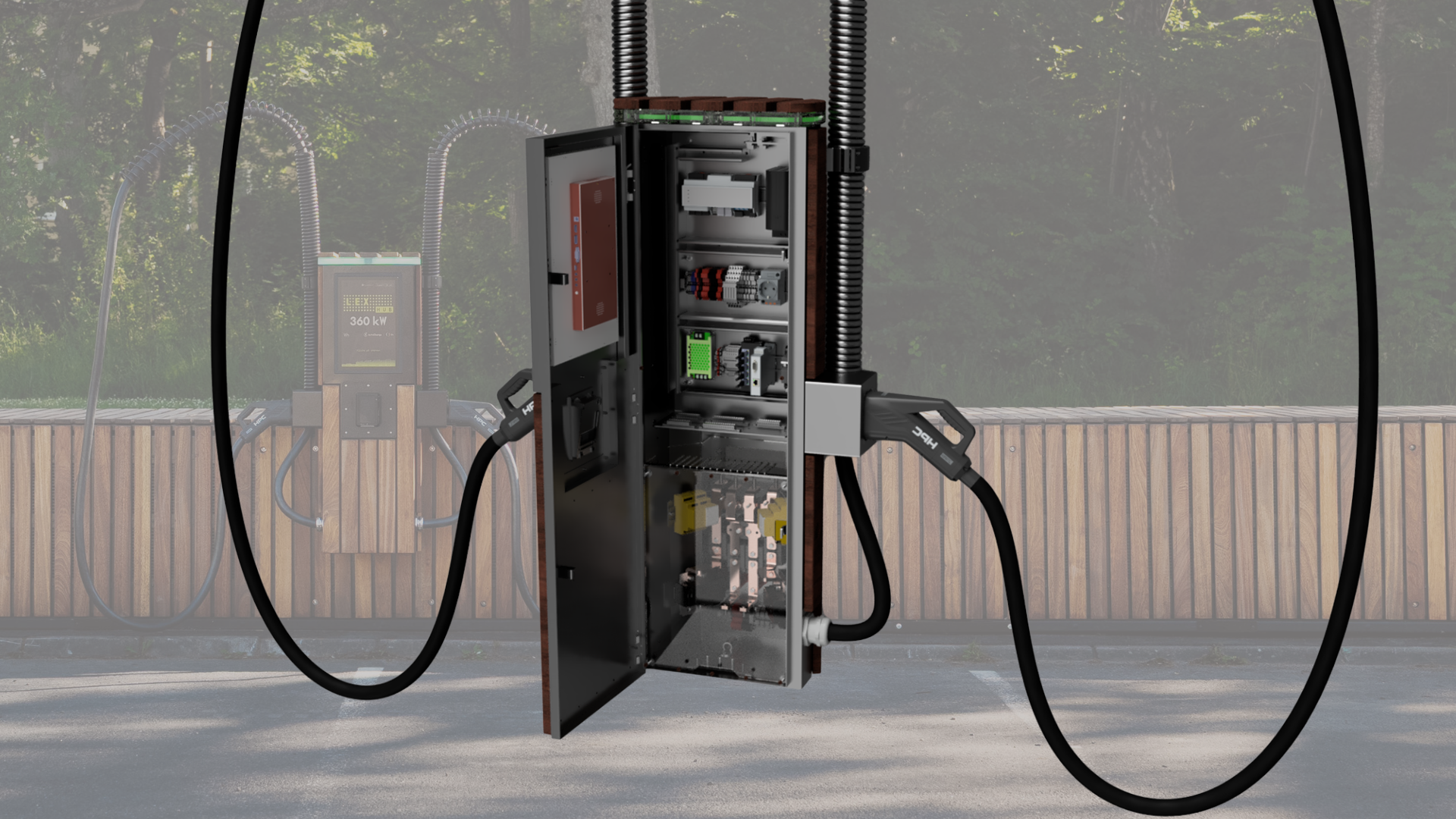
LexEnergy is launching LexHub Generation 2.5, the next evolution of its integrated fast-charging and energy infrastructure platform. The new version introduces LexPile, LexEnergy’s in-house developed next-generation DC charging system, and strengthens the platform across charging performance, interoperability, serviceability, and long-term operational reliability.
The fast-charging market is entering a new phase. Electric vehicles are becoming capable of higher charging speeds, charging networks are expanding, and customers increasingly expect charging to be fast, reliable, and simple to use. At the same time, local grid capacity remains one of the main barriers to deployment, especially for high-power charging sites.
For operators, retailers, utilities, property owners, and infrastructure partners, the challenge is no longer only to install chargers. The challenge is to build charging infrastructure that works reliably over time, integrates with the surrounding energy system, meets evolving regulatory requirements, and creates a strong business case.
This is where LexEnergy has focused from the beginning.
LexHub was developed as more than a fast charger. It is an integrated energy platform that combines DC fast charging, battery storage, and LexOS – LexEnergy’s proprietary software platform for dynamic power management, energy optimization, remote monitoring, and system control. With control over the hardware and the system, LexEnergy can unlock multiple revenue streams using the battery and platform not only for charging, but for grid support and optimization of the connected real estate. By managing charging demand, battery capacity, and grid interaction as one coordinated system, LexHub enables high-power charging even in locations where traditional charging infrastructure can be limited by grid constraints.
With LexHub Generation 2.5, LexEnergy is taking the next step in that development.
Building on a platform already proven in the field
LexHub Generation 2.0 marked an important milestone for LexEnergy, with live installations demonstrating how integrated charging and battery storage can reduce dependency on large grid upgrades, shorten deployment complexity, and improve site economics.
Generation 2.5 builds on that foundation. It is not a shift away from the existing platform, but a focused evolution of the system – with particular emphasis on the charging layer, user experience, serviceability, and long-term operational reliability.
At the core of this next generation is LexPile, LexEnergy’s in-house developed next-generation DC charging system.
Introducing LexPile
LexPile has been developed to meet the increasing demands placed on modern fast-charging infrastructure. As the market matures, charging systems must do more than deliver high output. They must communicate efficiently with a growing range of vehicles, integrate with different backend systems, support transparent billing, enable remote updates, and remain serviceable throughout their lifecycle.
LexPile is designed for this operating environment.
The system supports up to 400 kW charging capacity, enabling high-power charging and improved throughput at charging sites. Just as importantly, LexPile improves the communication between vehicle and charger, reducing the time from plug-in to active charging. For the driver, this means a faster and smoother charging experience. For the operator, it means better utilization of the charging asset and a more efficient site.
LexPile also supports key open standards, including ISO 15118, the standard for advanced vehicle-to-charger communication, with support for ISO 15118-20 and Plug & Charge functionality. This allows vehicles to identify and authenticate automatically, reducing friction from the user journey and limiting dependence on apps or RFID cards.
On the backend side, LexPile supports Open Charge Point Protocol (OCPP) 1.6J and OCPP 2.0.1, giving operators flexibility to integrate with different charge point management systems without unnecessary lock-in. The system is also designed with the EU Alternative Fuels Infrastructure Regulation (AFIR) requirements in mind and supports MID-certified energy measurement under the European Measuring Instruments Directive, enabling accurate, transparent, and compliant billing for public and commercial charging environments.
Together, these capabilities are central to where the market is heading: open, interoperable, reliable charging infrastructure that can scale across locations, vehicle types, operators, and regulatory frameworks.
With LexHub Generation 2.5, we are taking greater control of the charging system itself. That matters because performance in fast charging is not only about peak power; it is about how reliably the system communicates with vehicles, integrates with backend platforms, manages energy, and performs over time. LexPile gives us a stronger technical foundation for the next phase of charging infrastructure.
Andreas Stockman, Head of Technology at LexEnergy
A stronger full-stack approach
One of the key developments behind LexHub Generation 2.5 is that LexEnergy is taking greater control over the charging system itself. This strengthens control over performance, quality, diagnostics, service processes, and future development. It also makes the charging system more tightly integrated with the broader LexHub platform and LexOS.
For customers and partners, this matters.
Charging sites are often built and assembled by several suppliers, each delivering separate parts of the infrastructure: chargers, battery systems, backend platforms, payment systems, energy management software, and service operations. That can work, but it also increases complexity. When several suppliers and systems need to communicate with each other, performance depends on the quality of the integration.
LexEnergy’s approach is different. By combining hardware, software, and energy optimization in one coordinated platform, LexHub reduces system complexity and enables the infrastructure to operate as one energy asset rather than a collection of separate components.
With LexPile, that integration becomes even stronger.
Designed for real-world operations
As charging infrastructure scales, uptime and serviceability become business-critical. A charger that is difficult to maintain creates unnecessary downtime, higher operating costs, and a weaker customer experience.
LexPile has therefore been developed with a modular and service-oriented design, making the system easier to maintain and reducing operational complexity over time. Over-the-air updates allow software and functionality to be updated remotely, helping the system stay current as requirements evolve.
The system is also designed for safe and robust operation across different use cases and site environments. A premium enclosure, aligned with LexEnergy’s Nordic design language, gives the product a durable and high-quality expression suited for public spaces, retail environments, commercial sites, and charging hubs.
The goal is clear: charging infrastructure should not only perform at installation. It should continue to perform reliably throughout its lifecycle.
More than charging revenue
The business case for fast charging is becoming increasingly dependent on how well each site uses its available energy capacity. High-power charging creates value, but charging revenue alone can be unpredictable, especially during early utilization phases.
LexHub is designed to strengthen the business case by enabling value beyond charging sessions. Through LexOS, the system can optimize energy flows, manage peak demand, support flexible grid interaction, and help unlock additional revenue streams depending on site conditions and market opportunities. This makes LexHub relevant not only as a charging product, but as a broader energy infrastructure solution.
For retailers, it can improve the customer experience and turn parking into a more valuable asset. For charge point operators, it can support faster deployment and stronger utilization per grid connection. For utilities and grid-constrained locations, it can enable high-power charging while reducing stress on the local grid. For property owners and infrastructure partners, it creates a more future-proof foundation for electrification.
For our customers, the challenge is no longer simply to install chargers. They need infrastructure that works commercially, operationally, and technically over time. LexHub Generation 2.5 strengthens that business case by combining high-power charging with seamless integration across systems, easy service, and smart energy control of connected assets all in one integrated platform.
Sara Strand, Sales Manager at LexEnergy
Prepared for the next phase of electrification
The next phase of charging infrastructure will be defined by systems that are fast, reliable, interoperable, and financially viable.
As vehicles become more capable and regulatory expectations increase, infrastructure must keep pace. It is no longer enough to install charging capacity. Operators need systems that can be integrated, monitored, updated, maintained, and optimized over time.
LexHub Generation 2.5 has been developed for that reality.
By combining LexPile with LexEnergy’s established platform for battery-supported fast charging and intelligent energy control, LexHub Generation 2.5 strengthens LexEnergy’s position as a full-stack energy infrastructure company – delivering solutions that support electrification while addressing the grid, operational, and commercial challenges behind it.
LexEnergy’s ambition remains unchanged: to make electrification scalable, reliable, and commercially sustainable.
LexHub Generation 2.5 is the next step in that direction.
For more information, contact:
contact@lexenergy.se